Electricity Advanced: Power Systems, Protection and Machines
Motors, Generators and Transformers
In this lesson you will
- Explain how a motor and a generator use magnetic fields
- Calculate transformer voltages and currents using the turns ratio
- Describe efficiency and typical losses
Introduction
Electricity and magnetism are two sides of one force. Moving charge makes a magnetic field, and a changing magnetic field makes a voltage. Three machines are built on this: motors, generators and transformers.
Two key effects
- A current-carrying wire in a magnetic field feels a force. This is the principle of the motor.
- Moving a wire through a magnetic field (or changing the field around it) induces a voltage in the wire. This is electromagnetic induction, discovered by Faraday, and it is the principle of the generator and the transformer.
Motors
An electric motor turns electrical energy into rotation.
- Brushed DC motors: simple and cheap. Brushes switch the current in the coils so the rotor keeps turning. Speed depends on voltage, direction reverses with polarity, and brushes wear out.
- Brushless DC motors: electronics switch the coils, so there are no brushes. More efficient and longer-lived, common in drones and fans.
- Induction motors (AC): a rotating magnetic field in the stator drags the rotor round. Rugged and widely used in industry, particularly with three-phase supply.
- Stepper and servo motors: move precisely in steps or to commanded positions, used in printers and robots.
A turning motor generates a voltage that opposes the supply, called back-EMF. That is why a motor draws a large current at start-up, when it is stationary and has no back-EMF, and less when it is running.
Generators
A generator is a motor in reverse. Turning a coil in a magnetic field induces a voltage. Power stations spin generators with turbines driven by steam, gas, water or wind. Faster rotation or a stronger field gives more voltage. Rotating coils naturally produce AC, and the speed sets the frequency.
Quick quiz
Why does a motor draw a large current at the moment it starts?
Transformers
A transformer has two coils on a shared iron core, with no electrical connection between them. AC in the primary creates a changing magnetic field, which induces an AC voltage in the secondary.
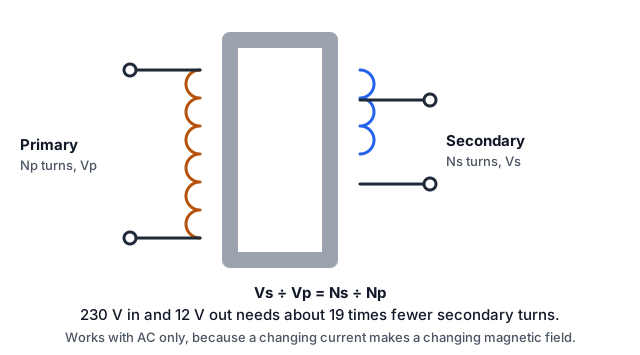 A transformer. The voltages are in the same ratio as the numbers of turns.
Vs ÷ Vp = Ns ÷ NpExample: a transformer turns 230 V into 12 V. The turns ratio is 230 ÷ 12 ≈ 19.2 : 1. If the primary has 1920 turns, the secondary needs about 100 turns.
An ideal transformer wastes no power, so power in = power out, and Vp × Ip = Vs × Is. Stepping the voltage down steps the current up. If the 12 V secondary supplies 2 A, the power is 24 W, and the primary current is about 24 ÷ 230 ≈ 0.10 A.
Key points:
- Transformers work with AC only. A steady DC gives no changing field.
- The secondary is isolated from the primary, which is useful for safety, although it does not make mains safe to touch.
- Real transformers lose a little energy as heat in the wire (copper loss) and core (iron loss), but large ones reach very high efficiency, often above 98 percent.
Efficiency
Efficiency = useful output power ÷ input power. If a motor takes 1000 W and delivers 850 W of mechanical power, its efficiency is 85 percent, and 150 W is lost as heat. Losses include resistance in the wires, friction, magnetic losses and, in electronics, switching. Heat must be removed with cooling, so machines have fans, fins and ratings that must not be exceeded.
Safety
Motors can start unexpectedly, trap fingers or clothing, and run hot. Transformers and machines connected to mains need proper enclosures, protection and trained installers. Experiment with small low-voltage motors and batteries.
Try it yourself
A transformer has 500 turns on the primary and 25 turns on the secondary, with a 230 V supply. Calculate the secondary voltage (11.5 V). If the secondary supplies 3 A, estimate the primary current, assuming an ideal transformer.
Summary
- Motors use the force on a current in a magnetic field, and generators use induction to produce voltage.
- Transformers change AC voltage in proportion to the turns ratio, and the current changes in the opposite direction.
- Efficiency compares output with input, and the losses appear as heat.
Lesson complete
+20 XP
Nice work. Keep going while it is fresh.
Sources and further reading