Electricity Basics: Voltage, Current and Circuits
Series and Parallel Circuits
In this lesson you will
- Tell series and parallel connections apart
- Calculate total resistance for each
- Explain why homes use parallel wiring
Introduction
Real circuits have many parts. There are only two basic ways to connect them: one after another, or side by side. Learn these two and you can understand any circuit.
Series: one path
In a series circuit, parts are connected end to end, so there is only one path for the current.
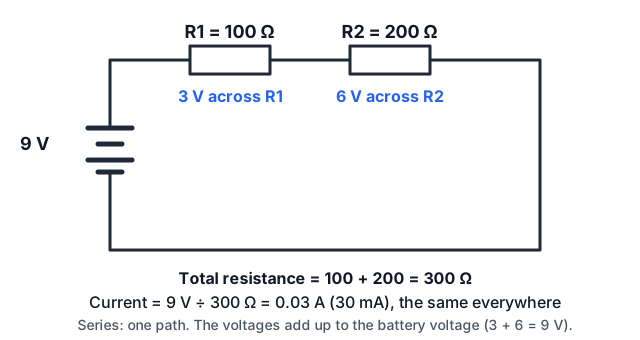 Series: the same current flows through every part, and the voltages share out.
Rules for series:
- The current is the same through every part.
- The voltages add up to the supply voltage (3 V + 6 V = 9 V).
- The resistances add: R total = R1 + R2 + R3 and so on.
In the diagram, R total = 100 + 200 = 300 Ω, so I = 9 ÷ 300 = 0.03 A. Then V across R1 is 0.03 × 100 = 3 V, and across R2 is 0.03 × 200 = 6 V.
A downside: if one part breaks, the loop opens and everything stops, like old strings of fairy lights.
Batteries in series add their voltages. Two 1.5 V cells in series give 3 V.
Quick quiz
Three resistors of 10 Ω, 20 Ω and 30 Ω are in series. What is the total resistance?
Parallel: many paths
In a parallel circuit, parts are connected side by side, so the current has more than one path.
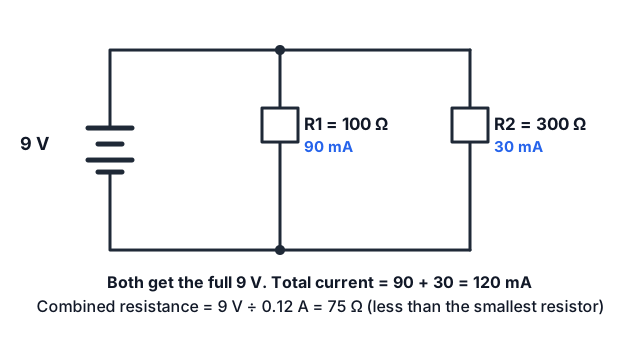 Parallel: every part gets the full voltage, and the currents add up.
Rules for parallel:
- The voltage is the same across every branch.
- The currents add up to the total current (90 mA + 30 mA = 120 mA).
- The total resistance is smaller than the smallest branch.
For two resistors, the shortcut is:
R total = (R1 × R2) ÷ (R1 + R2) = (100 × 300) ÷ (100 + 300) = 75 ΩCheck it with Ohm's law: 9 V ÷ 75 Ω = 0.12 A, which is 120 mA. It matches.
More branches means more current drawn from the source, which is why plugging too many devices into one socket can overload it.
Why homes use parallel
Lights and sockets in a building are wired in parallel. Each gets the full supply voltage, and switching one off or a bulb failing does not stop the others.
Both together
Real circuits mix them. To solve one, simplify step by step: replace each parallel group with its single equivalent resistance, then add the series parts.
Try it yourself
Two 200 Ω resistors are in parallel across a 10 V supply. Find the total resistance, the total current, and the current in each resistor.
Summary
- Series: one path, same current, voltages add and resistances add.
- Parallel: several paths, same voltage, currents add, and the total resistance is lower.
- Homes use parallel wiring so devices work independently.
Lesson complete
+20 XP
Nice work. Keep going while it is fresh.
Sources and further reading