Electricity Basics: Voltage, Current and Circuits
What Is Electricity?
In this lesson you will
- Explain voltage, current and resistance in plain words
- Tell conductors and insulators apart
- Describe what makes a complete circuit
Introduction
Electricity powers your phone, lights and almost everything around you, but it is invisible, which makes it feel mysterious. In this lesson you will meet the three ideas that explain nearly everything in electronics: voltage, current and resistance.
The simple explanation
Electricity is the flow of tiny charged particles, called electrons, through a material.
Everything is made of atoms. Some materials, mostly metals such as copper, let electrons move easily. When electrons are pushed along a path, they carry energy that can light a bulb, spin a motor or run a computer.
The water analogy
Think of water in pipes. It is not perfect, but it helps:
- Voltage is like water pressure. It is the push that makes electrons move. It is measured in volts (V).
- Current is like the flow of water. It is how much charge passes each second, measured in amps (A).
- Resistance is like a narrow pipe that makes it harder for water to flow. It is measured in ohms (Ω).
More pressure gives more flow. A narrower pipe gives less flow. The next lesson turns this into a simple rule.
Quick quiz
In the water analogy, what does voltage correspond to?
Conductors and insulators
- Conductors let current flow easily, such as copper, aluminium and most metals. Wires are made of them.
- Insulators block current, such as plastic, rubber, glass and dry wood. The coating on a wire is an insulator.
Water with minerals in it, and the human body, can conduct electricity. That is why electricity can be dangerous. The last lesson in this course is about safety.
A complete circuit
Current only flows when it has a complete loop to travel around. A simple circuit needs:
- A source that provides the push, such as a battery
- Wires to carry the current
- A load, something that uses the energy, such as a lamp
- Often a switch to open or close the loop
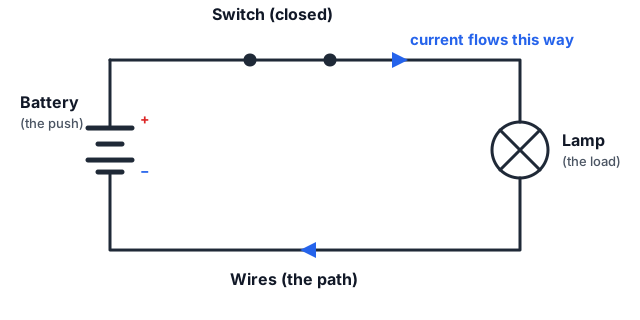 A simple circuit. When the switch is closed, current flows round the loop. Open the switch and the loop is broken, so the lamp goes out.
By convention, we draw conventional current flowing from the positive terminal of the battery, around the circuit, and back to the negative terminal. (Electrons actually move the other way, but the convention is used everywhere, so you learn it that way.)
DC and AC
- DC (direct current) flows in one direction. Batteries and USB chargers provide DC.
- AC (alternating current) keeps changing direction many times a second. The mains electricity in wall sockets is AC.
This course starts with safe, low-voltage DC from batteries.
Try it yourself
Without any equipment, draw a circuit with a battery, a switch and a bulb. Mark where the current flows when the switch is closed, and say what happens to the bulb when it is open.
Summary
- Electricity is the flow of charge. Voltage is the push, current is the flow, and resistance opposes it.
- Conductors let current through, and insulators block it.
- Current needs a complete loop. Batteries give DC, and wall sockets give AC.
Lesson complete
+20 XP
Nice work. Keep going while it is fresh.