Electricity Intermediate: AC, Circuit Laws and Energy Storage
Capacitors, Inductors and Time
In this lesson you will
- Explain how a capacitor stores energy and charges through a resistor
- Calculate an RC time constant
- Describe what an inductor does and the need for a flyback diode
Introduction
Resistors react instantly: change the voltage and the current changes at once. Capacitors and inductors store energy, so they bring time into circuits. They create delays, smooth supplies, filter signals and make oscillators.
Capacitors
A capacitor stores energy as electric charge on two plates separated by an insulator. Its capacitance C is in farads (F), usually microfarads (µF), nanofarads (nF) or picofarads (pF).
- It blocks steady DC once charged, but passes changing signals.
- Energy stored: E = ½ × C × V². A 1000 µF capacitor at 10 V stores 0.5 × 0.001 × 100 = 0.05 joules.
- Large capacitors can keep a dangerous charge after power is removed, in mains equipment especially. This is another reason never to open mains devices.
Charging through a resistor
When a capacitor charges through a resistor, the voltage rises quickly at first and then slows.
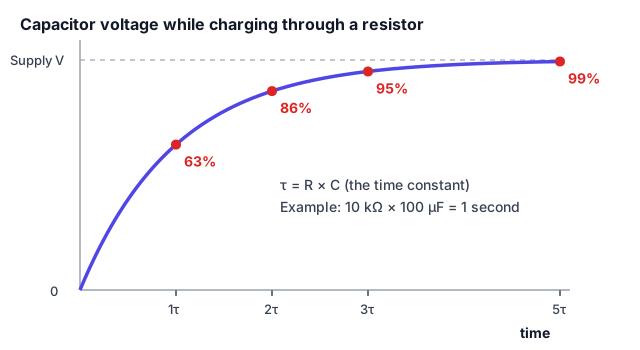 An RC charging curve. After 1τ the capacitor is at 63 percent of the supply, after 5τ it is effectively full.
The speed is set by the time constant:
τ = R × CFor R = 10 kΩ and C = 100 µF: τ = 10,000 × 0.0001 = 1 second.
After 1τ: about 63 percent. After 2τ: 86 percent. After 3τ: 95 percent. After 5τ: over 99 percent, so we usually say it is "fully charged" after about five time constants. Discharging works the same way in reverse: it falls to about 37 percent after one τ.
Quick quiz
What is the time constant of a 100 kΩ resistor and a 10 µF capacitor?
Uses
- Smoothing power supplies (next lessons)
- Decoupling: small capacitors beside chips supply sudden bursts of current
- Timing and delays with a resistor
- Filters: passing some frequencies and blocking others
Inductors
An inductor is a coil of wire. It stores energy in a magnetic field. Its inductance L is measured in henrys (H).
- It resists changes in current. Current through an inductor cannot change instantly.
- It passes steady DC easily and opposes fast changes, the opposite of a capacitor.
- Uses: filters, power converters, transformers and motors.
The flyback problem
When you suddenly switch off current through an inductor, such as the coil of a relay or motor, the collapsing field creates a large voltage spike that can destroy a transistor or microcontroller. The fix is a flyback diode across the coil, pointing so it normally does not conduct, which gives the current a safe path when the switch opens.
Try it yourself
Choose a resistor and capacitor from your parts to make a time constant of about half a second. Calculate it. Then explain why a capacitor wired across a power supply smooths the voltage.
Summary
- Capacitors store charge, block steady DC and charge through a resistor with time constant τ = R × C.
- After five time constants a capacitor is effectively fully charged.
- Inductors resist changes in current, and a flyback diode protects circuits from the spike when an inductive load is switched off.
Lesson complete
+20 XP
Nice work. Keep going while it is fresh.
Sources and further reading