Electricity Intermediate: AC, Circuit Laws and Energy Storage
AC and Mains Electricity
In this lesson you will
- Describe AC as a changing voltage with frequency and period
- Explain the difference between peak and RMS values
- Understand why mains is AC and why it must be respected
Introduction
So far you have used batteries, which give direct current (DC): the voltage stays steady and current flows one way. The sockets in your walls supply something different, alternating current (AC). This lesson explains AC, and it is about understanding. Never work on mains wiring unless you are properly qualified.
The simple explanation
In AC, the voltage keeps swinging up and down, and the current changes direction, many times every second.
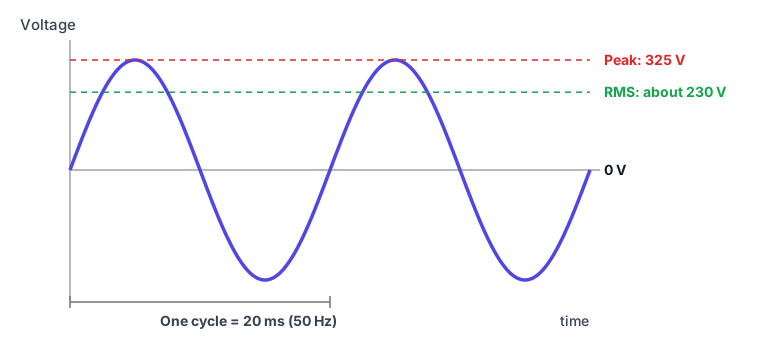 Mains AC is a sine wave. In a 50 Hz system one cycle takes 20 ms. The peak is higher than the RMS value that we quote as the voltage.
Frequency and period
- Frequency is how many complete cycles happen each second, measured in hertz (Hz). Mains is 50 Hz in much of the world and 60 Hz in others, including North America.
- The period is the time of one cycle: T = 1 ÷ f. At 50 Hz, T = 1 ÷ 50 = 0.02 s = 20 ms. At 60 Hz it is about 16.7 ms.
Quick quiz
What is the period of a 50 Hz signal?
Peak and RMS
An AC voltage is not constant, so which number do we quote? Two are common:
- Peak voltage (Vpeak): the highest point of the wave.
- RMS voltage (root mean square): the equivalent DC value that would heat a resistor by the same amount. For a sine wave, Vrms = Vpeak ÷ √2, about 0.707 × Vpeak.
When we say "230 V mains", we mean RMS. The peak is about 230 × 1.414 ≈ 325 V. In a 120 V system the peak is about 170 V. Meters on the AC setting usually show RMS.
Why mains is AC
- Transformers can raise and lower AC voltages easily and efficiently. High voltage for long-distance transmission, low voltage for homes (see later lessons).
- Generators naturally produce AC as coils spin in a magnetic field.
Electronic gadgets use DC inside, so they contain power supplies that convert AC to DC. You will see how in the Electronics courses.
Mains is dangerous
- Mains voltage is high enough to push a harmful or lethal current through the body.
- Wet conditions make it more dangerous.
- Protective devices such as fuses, circuit breakers and residual current devices (RCDs) exist for good reasons, and they are covered in the advanced course.
- Never open mains equipment, modify wall wiring or make your own mains connections. Use a licensed electrician.
- Learn electronics with batteries and low-voltage supplies, and use ready-made, approved power adaptors.
Try it yourself
Without touching any mains equipment, read the label on a phone charger or laptop adaptor. Find the input voltage range and frequency, the output voltage and current. Calculate the peak of its lowest input voltage.
Summary
- AC alternates direction, with frequency in hertz and period T = 1 ÷ f.
- RMS is the DC-equivalent value, and Vrms = Vpeak ÷ √2, so 230 V RMS has a peak of about 325 V.
- Mains is AC because transformers make it easy to transmit, and it is dangerous, so only qualified people work on it.
Lesson complete
+20 XP
Nice work. Keep going while it is fresh.