Electricity Intermediate: AC, Circuit Laws and Energy Storage
Kirchhoff's Laws and Voltage Dividers
In this lesson you will
- State Kirchhoff's current law and voltage law
- Calculate the output of a voltage divider
- Use these laws to solve a small circuit
Introduction
Ohm's law handles one resistor. For circuits with several parts, you need two more rules. They are two statements of things that must be conserved: charge and energy.
Kirchhoff's current law (KCL)
The current flowing into a junction equals the current flowing out.
Charge cannot pile up or vanish at a junction. You already used this in the parallel circuit, where 90 mA and 30 mA combined to 120 mA.
I_in = I_out1 + I_out2
120 mA = 90 mA + 30 mA
Kirchhoff's voltage law (KVL)
Going around any closed loop, the voltage rises and drops add up to zero. Equivalently, the voltage drops across the parts equal the supply voltage.
In the series circuit with a 9 V battery, 3 V across R1 and 6 V across R2: 9 − 3 − 6 = 0.
Quick quiz
Currents of 2 A and 3 A flow into a junction. What current flows out in total?
The voltage divider
Two resistors in series across a supply split the voltage in proportion to their resistances. The voltage across R2, measured between the middle and ground, is:
Vout = Vin × R2 ÷ (R1 + R2)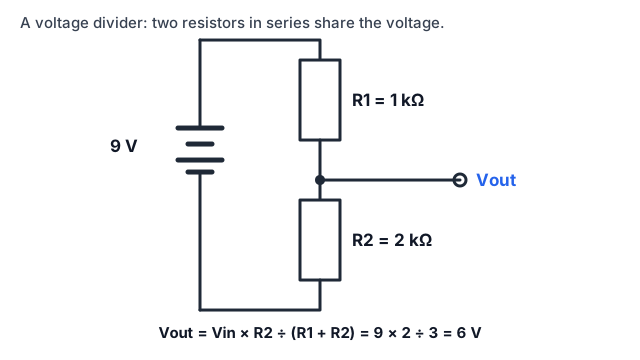 A voltage divider. With R1 = 1 kΩ and R2 = 2 kΩ, Vout = 9 × 2 ÷ 3 = 6 V.
Check with Ohm's law: the current is 9 V ÷ 3 kΩ = 3 mA, so R2 drops 3 mA × 2 kΩ = 6 V. It agrees.
Uses
- Scaling a high voltage down so a microcontroller can measure it
- Setting a reference level
- Sensors: a light sensor or thermistor in a divider turns resistance into a voltage you can read
An important limit
The formula assumes nothing is drawn from the output. If you connect a load, it is in parallel with R2, which lowers the output. As a rule of thumb, the load resistance should be much larger than R2, such as ten times or more. A divider is not a good way to power anything that takes real current. Use a regulator for that.
A worked example
A 12 V supply, R1 = 10 kΩ, R2 = 5 kΩ. What is Vout, and what current flows?
Vout = 12 × 5 ÷ (10 + 5) = 4 V
I = 12 ÷ 15 kΩ = 0.8 mA
Power is tiny, 12 V × 0.8 mA = 9.6 mW, so ordinary resistors are fine.
Try it yourself
You have a 5 V supply. Choose two standard resistors for a divider giving about 3.3 V. Calculate the exact output and the current. Hint: the output is about two-thirds of the supply.
Summary
- KCL: current into a junction equals the current out. KVL: voltages around a loop sum to zero.
- A voltage divider gives Vout = Vin × R2 ÷ (R1 + R2).
- It works only when the load draws very little current compared with the divider.
Lesson complete
+20 XP
Nice work. Keep going while it is fresh.
Sources and further reading