Electronics Basics: Components and Your First Circuit
Components: Resistors, Capacitors, Diodes and LEDs
In this lesson you will
- Describe what resistors, capacitors, diodes and LEDs do
- Recognise their symbols
- Know which parts have polarity
Introduction
Electronics circuits are built from a small set of basic parts. Learn what each part does, and circuits stop looking like a mystery. Safety first: this course uses low-voltage batteries or USB power only. If you have not read the electrical safety lesson, do that first.
Symbols for the parts
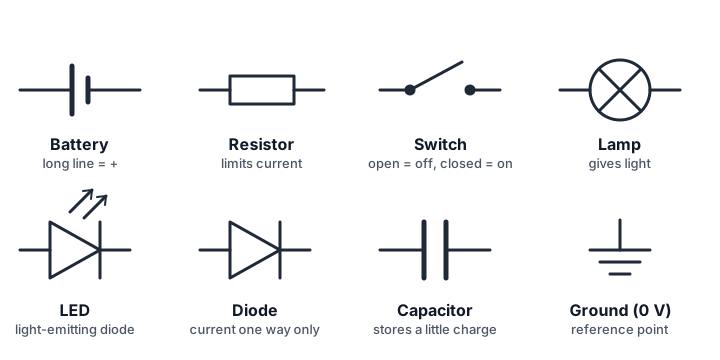 Common circuit symbols. You will see these in every circuit diagram.
Resistor
A resistor limits the flow of current. It is the most common part. Its value is in ohms (Ω), shown with colour bands (next lesson). Resistors have no polarity: they work the same either way round.
Uses: protecting LEDs, setting voltages, pulling signals up or down.
Capacitor
A capacitor stores a small amount of electric charge, like a tiny rechargeable battery that charges and discharges very quickly. It is measured in farads (F), usually microfarads (µF) or nanofarads (nF).
Uses: smoothing power, filtering noise, timing.
- Small ceramic capacitors have no polarity.
- Electrolytic capacitors (the little cans) do have polarity. A stripe marks the negative leg. Connect one backwards and it can fail, even burst. Also never exceed its voltage rating.
Diode
A diode lets current flow one way only, like a one-way valve. The stripe on the body marks the cathode (the end current flows towards). In the symbol, the triangle points in the direction that current can flow.
Uses: protecting circuits from wrong-way power, converting AC to DC.
LED
An LED (light-emitting diode) is a diode that gives off light when current flows through it the right way.
- It has polarity. The longer leg is the anode (+), and the shorter leg, with a flat edge on the bulb, is the cathode (−).
- It needs a resistor in series to limit current, or it can burn out in a moment. You will calculate it in the last lesson.
Quick quiz
Which of these parts must be connected the right way round?
Transistor, a peek ahead
A transistor is like an electronic switch or amplifier. A small current or voltage at one pin controls a larger current between two others. Transistors are the building blocks of computers, with billions inside a chip. You will meet them later.
Quick reference
| Part | Job | Polarity? |
|---|---|---|
| Resistor | Limits current | No |
| Capacitor (ceramic) | Stores a little charge | No |
| Capacitor (electrolytic) | Stores more charge | Yes |
| Diode | One-way current | Yes |
| LED | Gives light | Yes |
Try it yourself
If you have any old, unplugged electronics parts or a beginner kit, sort the parts into resistors, capacitors, diodes and LEDs. Mark every part that has polarity.
Summary
- Resistors limit current, capacitors store charge, diodes pass current one way, and LEDs make light.
- Diodes, LEDs and electrolytic capacitors have polarity. Resistors do not.
- An LED always needs a resistor in series.
Lesson complete
+20 XP
Nice work. Keep going while it is fresh.
Sources and further reading