Electronics Basics: Components and Your First Circuit
Reading Circuit Diagrams and Resistor Codes
In this lesson you will
- Follow a simple schematic from battery to ground
- Read the colour bands on a resistor
- Convert between ohms, kilohms and megohms
Introduction
A schematic is the map of a circuit. It shows how parts connect, not what they look like. Once you can read one, you can build and understand circuits from anywhere in the world.
How to read a schematic
- Each part is drawn as a symbol, with a label such as R1 for the first resistor, C1 for a capacitor, and D1 for a diode.
- Lines are wires. A dot where lines cross means they connect. Lines crossing without a dot do not connect.
- Values appear next to parts, such as 150 Ω or 100 µF.
- Ground is the 0 V reference point, usually the battery's negative side.
- Current is usually drawn from the positive supply at the top, through parts, to ground at the bottom.
To follow a circuit: start at the positive terminal, trace the wire through each part in order, and end at the negative terminal. Ask at each junction: does the current split (parallel) or continue (series)?
In the last lesson you will build an LED circuit. In its diagram, start at the 5 V battery, go through the resistor, then the LED, then back to the battery. It is a series circuit.
Resistor colour code
Small resistors are too tiny to print numbers on, so they use coloured bands.
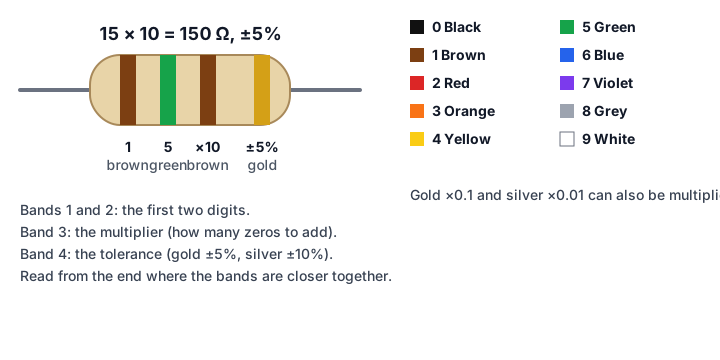 The resistor colour code. Digits 0 to 9 are black, brown, red, orange, yellow, green, blue, violet, grey and white.
For a four-band resistor:
- Band 1: first digit
- Band 2: second digit
- Band 3: multiplier (how many zeros to add, or ×10 to the power)
- Band 4: tolerance. Gold is ±5%, silver is ±10%.
Example: brown, green, brown, gold means 1, 5, ×10, ±5%, which is 150 Ω.
Another: red, red, orange, gold means 2, 2, ×1,000, which is 22,000 Ω, written 22 kΩ.
Quick quiz
A resistor has bands of yellow, violet, red, gold. What is its value?
Tips: read from the end where the bands are closer together, and with a multimeter you can check the value for certain.
Writing values
- Below 1,000: write ohms, such as 470 Ω.
- 1,000 and up: kilohms, such as 4.7 kΩ = 4,700 Ω.
- 1,000,000 and up: megohms, such as 1 MΩ.
Resistors come in standard values, such as 100, 150, 220, 330, 470 and 1 kΩ. You pick the nearest standard value to what you calculate.
Try it yourself
Decode these: (1) orange, orange, brown, gold. (2) brown, black, red, gold. (3) green, blue, orange, gold. Check your answers: 330 Ω, 1 kΩ and 56 kΩ.
Summary
- A schematic shows connections, using symbols, labelled parts, dots for joined wires and a ground reference.
- Resistor bands give two digits, a multiplier and a tolerance.
- Use standard resistor values, and a multimeter to confirm.
Lesson complete
+20 XP
Nice work. Keep going while it is fresh.
Sources and further reading